01
Basics on Leather & Suede
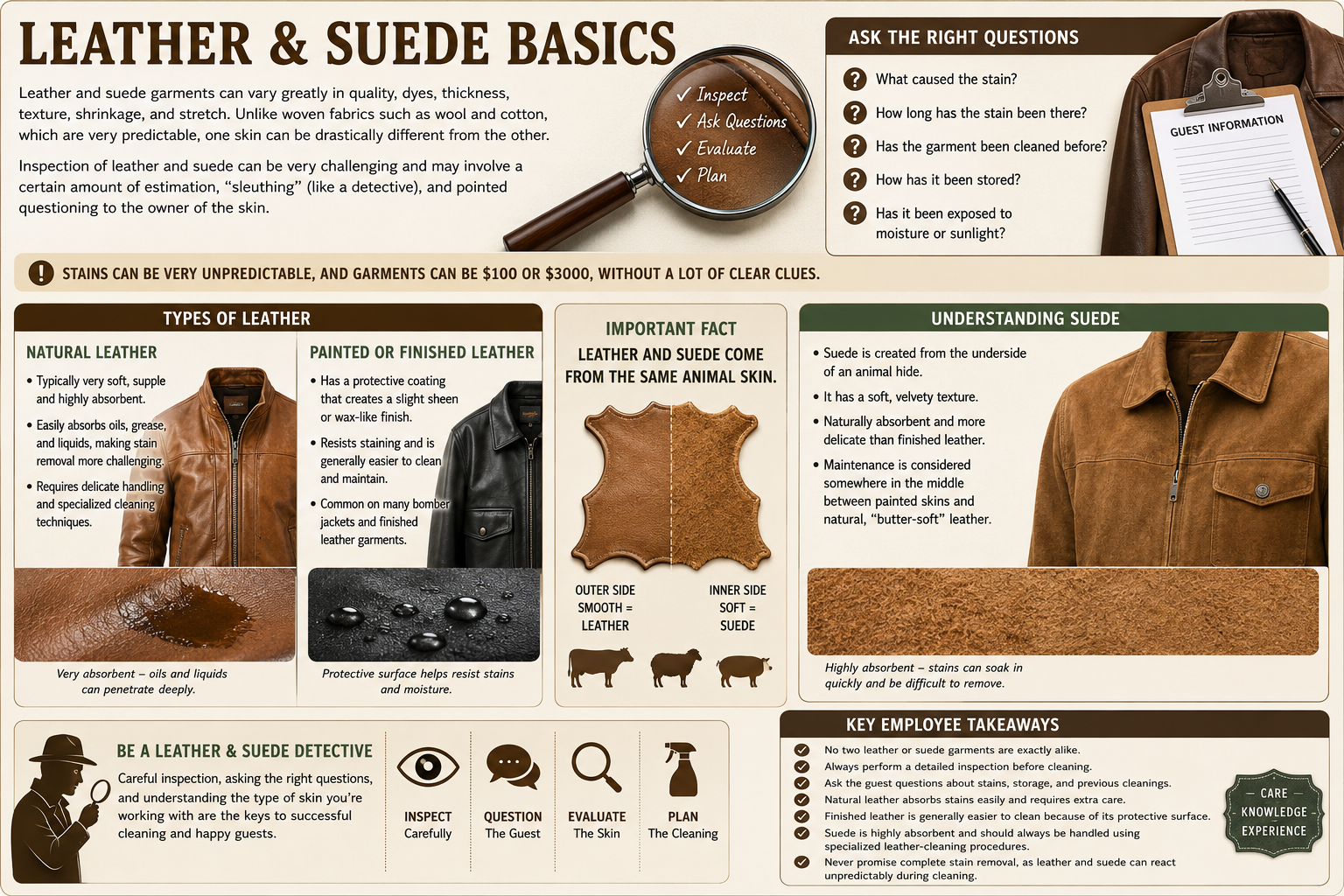
Leather and suede garments can vary greatly in quality, dyes, thickness and texture of skins, shrinkage, and stretch. Unlike woven fabrics such as wool and cotton, which are very predictable, one skin can be drastically different from the other. Inspection of leather and suede can be very challenging and may involve a certain amount of estimation, “sleuthing” (like a detective), and pointed questioning to the owner of the skin; what kind of stain, how long it’s been there, how the garment has been stored, if it’s been cleaned before … Stains can be very unpredictable, and garments can be $100 or $3000, without a lot of clear clues.
Some leathers are “natural,” which are often very soft and very absorbent. They can really hold on to stains – especially oil. Other leathers are “painted,” meaning they have sheen and a bit of a waxy finish – like a “bomber” jacket. These skins are easier to clean and maintain. Suede, on the other hand, is almost always absorbent and maintenance is considered somewhere in the middle between painted skins and natural, “butter-soft” leather skins.
* An animal skin produces leather on one side and suede on the other.
02
INSPECTION
Jackets & Upper-Body Garments
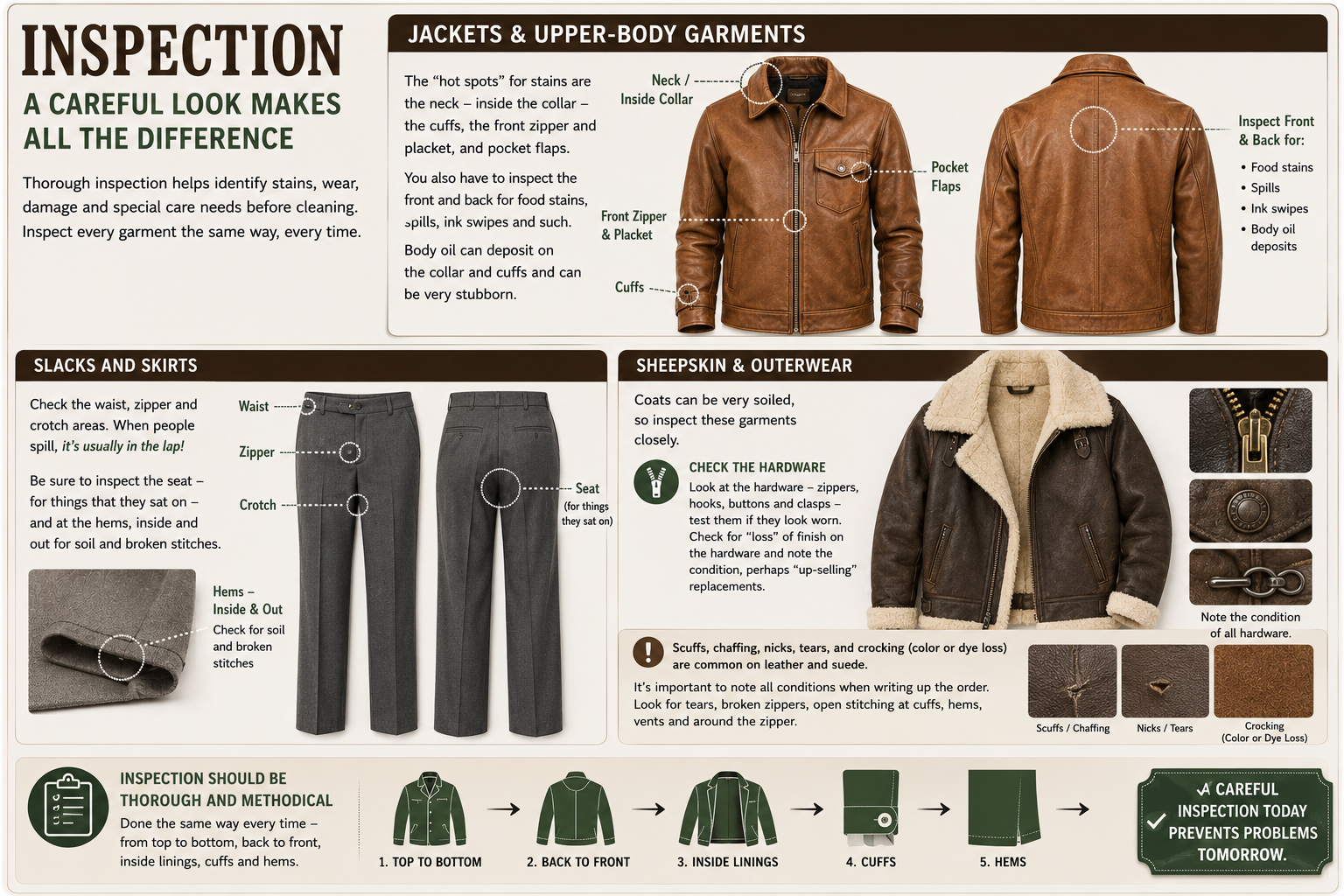
The “hot spots” for stains are the neck – inside the collar – the cuffs, the front zipper and placket, and pocket flaps. You also have to inspect the front and back for food stains, spills, ink swipes and such. Body oil can deposit on the collar and cuffs and can be very stubborn.
Slacks and Skirts
Check the waist, zipper and crotch areas. When people spill, it’s usually in the lap! Be sure to inspect the seat – for things that they sat on – and at the hems, inside and out for soil and broken stitches.
Sheepskin & Outerwear
Coats can be very soiled, so inspect these garments closely. Look at the hardware – zippers, hooks, buttons and clasps – test them if they look worn. Check for “loss” of finish on the hardware and note the condition, perhaps “up-selling” replacements.
Scuffs, chaffing, nicks, tears, and crocking (color or dye loss) are common on leather and suede. It’s important to note all conditions when writing up the order. Look for tears, broken zippers, open stitching at cuffs, hems, vents and around the zipper.
Inspection should be thorough and methodical – done the same way every time – from top to bottom, back to front, inside linings, cuffs and hems.
03
STAINS & IDENTIFICATION
Leather
Stain removal can be a challenge. Simple oily stains on a woven garment can create real headaches on leather garments. Natural skins, of all colors, are very absorbent. If you wet the tip of your finger and touch the inside of a natural skin, the moisture will be absorbed immediately. This type of skin will quickly absorb body oils from the hands and neck, lipstick, ink pen swipes, water-based spills, oily foods, and grease.
The same “wet test” performed on a painted skin will not be instantly absorbed. Painted skins will get the same stains as natural skins, but many will “sit” on the surface, making removal much easier. Some stains can actually be wiped off with a damp sponge.
Suede
Surprisingly, suede is a bit easier to care for than natural leather. Spills from milk, blood, and other protein stains can be challenging to remove – so be sure to share this information with your customer during inspection. Oily stains, in some cases, can be easier to remove than from leather.
04
Stain Identification
Most water-based stains such as soda, coffee, milk and perspiration will have an outline. Most oil-based stains are absorbed into the material and do not have an outline around the outside. Educate your customer … the more information you share, the more they will learn about caring for their skins. The more you teach them, the more committed they will be to you’re your business.
Covering stains … Painted leathers can usually be re-dyed after cleaning to cover many stains. Natural leathers cannot always be dyed. Suede can sometimes be re-dyed, but not as easily as leather.
** When a skin has body oil on the collar or cuffs and it is worn over and over without cleaning, the stains become embedded and are much harder to remove.
05
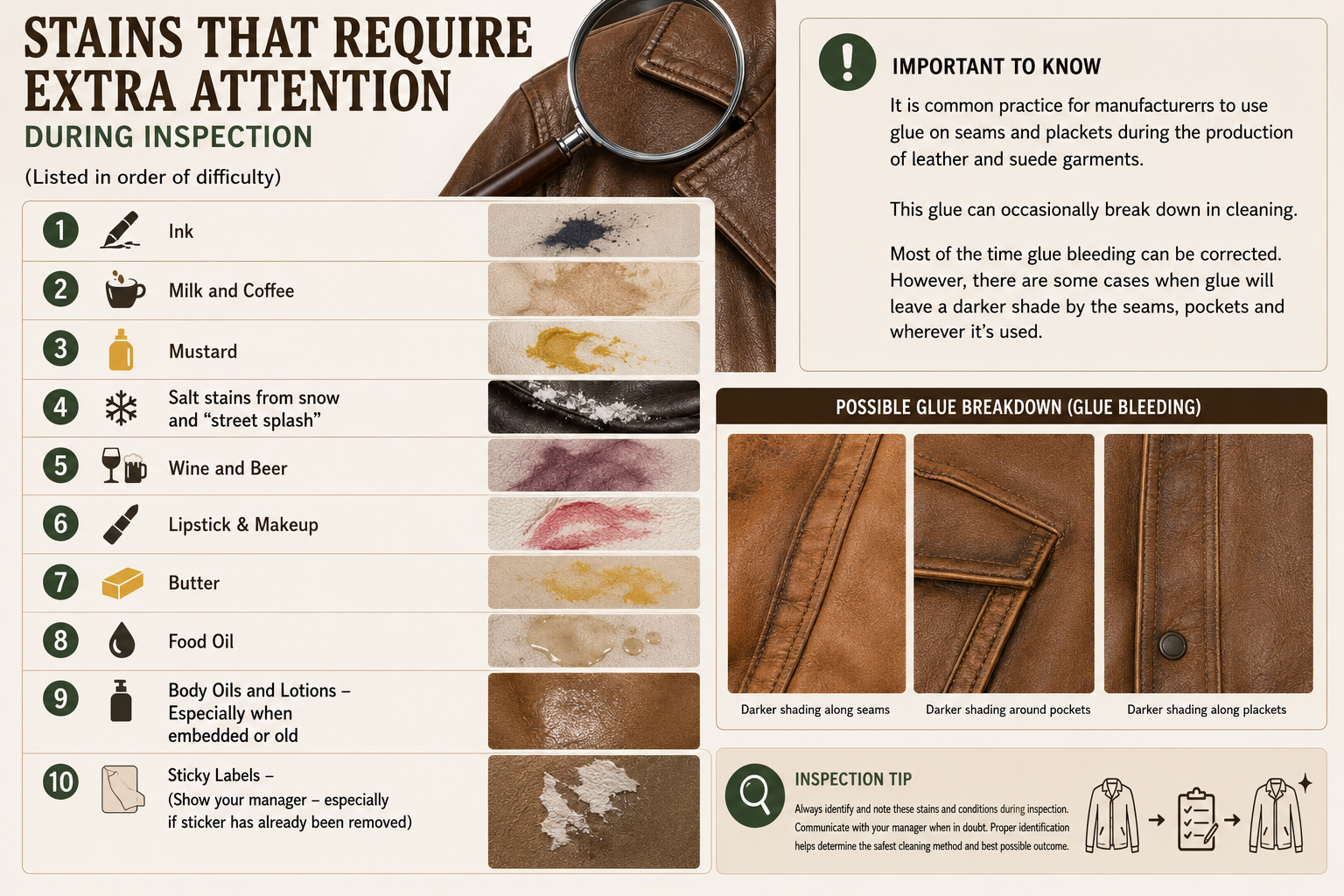
These stains require EXTRA attention during inspection. (Listed in order of difficulty)
- Ink
- Milk and Coffee
- Mustard
- Salt stains from snow and “street splash”
- Wine and Beer
- Lipstick & Makeup
- Butter
- Food Oil
- Body Oils and Lotions – Especially when embedded or old
- Sticky Labels – (Show your manager – especially if sticker has already been removed)
** It is common practice for manufacturers to use glue on seams and plackets during the production of leather and suede garments. This glue can occasionally break down in cleaning. Most of the time glue bleeding can be corrected. However, there are some cases when glue will leave a darker shade by the seams, pockets and wherever it’s used.
06
PRE-EXISTING CONDITIONS
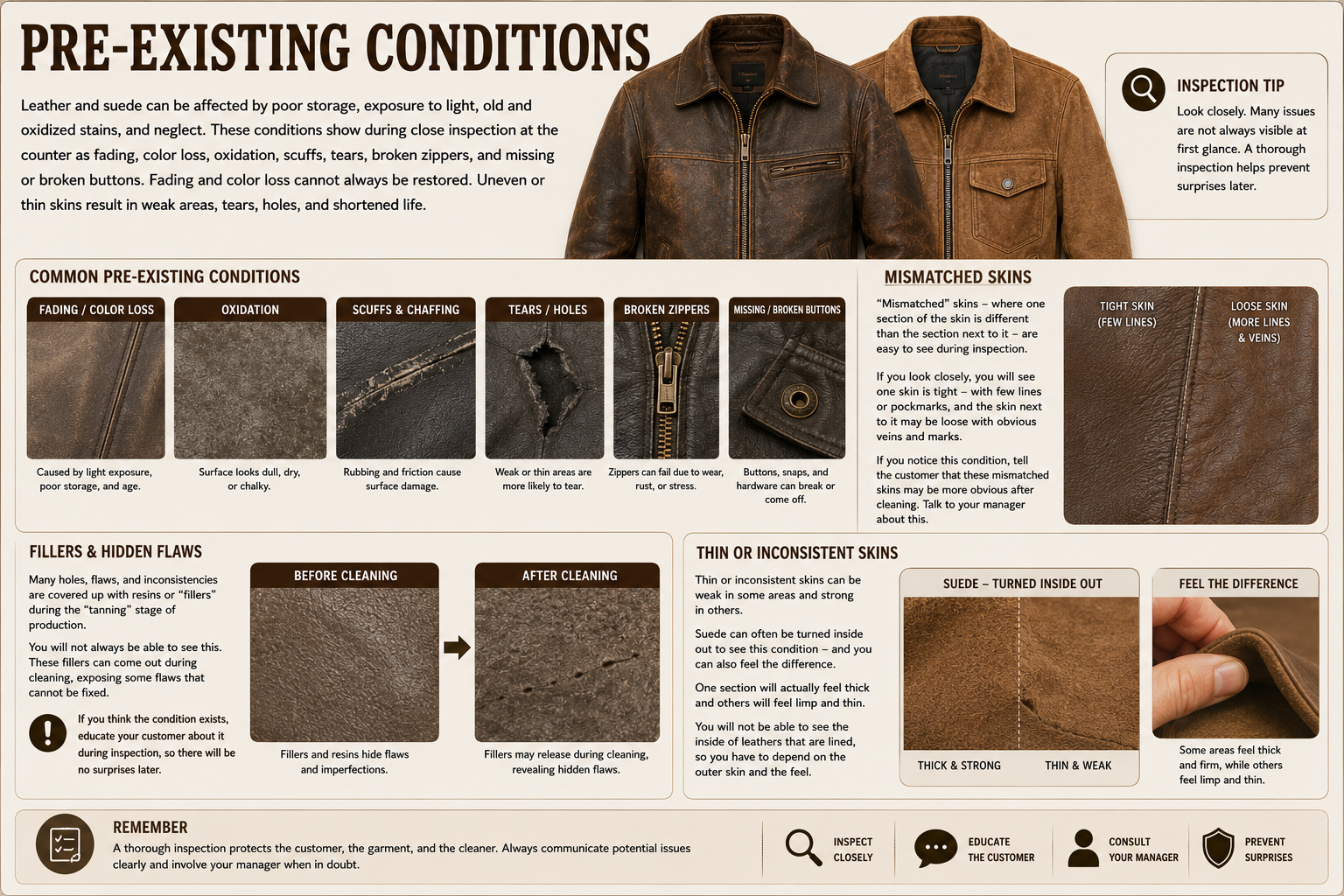
Leather and suede can be affected by poor storage, exposure to light, old and oxidized stains, and neglect. These conditions show during close inspection at the counter as fading, color loss, oxidation, scuffs, tears, broken zippers, and missing or broken buttons. Fading and color loss cannot always be restored. Uneven or thin skins result in weak areas, tears, holes, and shortened life.
“Mismatched” skins – where one section of the skin is different than the section next to it – are easy to see during inspection. If you look closely, you will see one skin is tight – with few lines or pockmarks, and the skin next to it may be loose with obvious veins and marks. If you notice this condition, tell the customer that these mismatched skins may be more obvious after cleaning. Talk to your manager about this.
Many holes, flaws, and inconsistencies are covered up with resins or “fillers” during the “tanning” stage of production. You will not always be able to see this. These fillers can come out during cleaning, exposing some flaws that cannot be fixed. If you think the condition exists, educate your customer about it during inspection, so there will be no surprises later.
Thin or inconsistent skins can be weak in some areas and strong in others. Suede can often be turned inside out to see this condition – and you can also feel the difference. One section will actually feel thick and others will feel limp and thin. You will not be able to see the inside of leathers that are lined, so you have to depend on the outer skin and the feel.
07
Hidden Conditions
Shrinkage and stretching can occur during cleaning, depending on the way the skins were stabilized when they were “cured.” The skins “relax” from their “overstretched” state during tanning and shrink back during cleaning.
Note: Skins are stretched during tanning so that each skin will make as many garments as possible. The skins are then dried in this stretched condition. During cleaning, the skin may “relax” back to its original “pre-stretched” size.
08
HAND CLEANING & MACHINE CLEANING
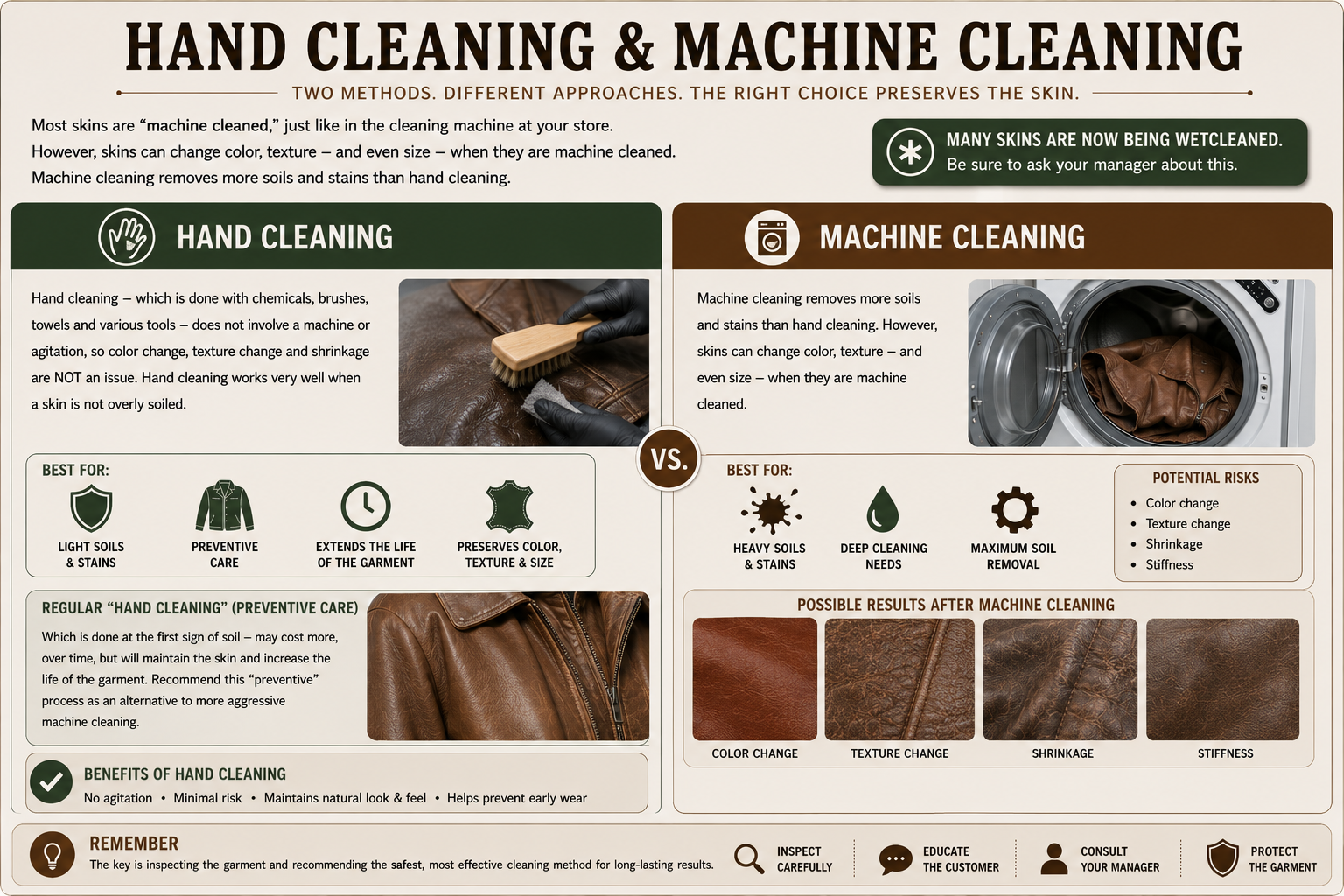
Most skins are “machine cleaned,” just like in the cleaning machine at your store. However, skins can change color, texture – and even size – when they are machine cleaned. Machine cleaning removes more soils and stains than hand cleaning.
Hand cleaning – which is done with chemicals, brushes, towels and various tools – does not involve a machine or agitation, so color change, texture change and shrinkage are NOT an issue. Hand cleaning works very well when a skin is not overly soiled.
Regular “Hand Cleaning” – which is done at the first sign of soil – may cost more, over time, but will maintain the skin and increase the life of the garment. Recommend this “preventive” process as an alternative to more aggressive machine cleaning.
* Many skins are now being wetcleaned. Be sure to ask your manager about this.
09
REPAIRS & ALTERATIONS
The typical problems with leather and suede are nicks and tears in the skin, panel replacement, zipper replacement, and heavy scuffing where the top layer of the skin has come off and the dye has been removed.
Scuffs, Nicks, Tears
Scuffs are usually re-dyed, without a repair. Nicks are very common and can occur easily with softer skins. They are routinely re-glued by the leather cleaner, free of charge, as part of the process after cleaning. Small tears (see photo and close-up) are glued back down. These tears are typically V-shaped or L-shaped and require an extra repair fee. They can often be disguised and re-dyed, but may still show, depending on the color, skin, and size.
Larger tears that commonly occur from brushing up against a sharp item tend to tear large slices of leather and are often too unsightly to re-glue. In these situations, it is common to replace the panel or section. The leather cleaner probably has an alteration department
with plenty of scraps. If they don’t have the right piece to match, then it can be ordered and the result can be quite impressive.
Hems & Cuffs
Shortening sleeves and hems are routine, but not always inexpensive. Your seamstress may be able to do these repairs “in-house.” However, many times they need to be sent to the leather cleaner. Lengthening sleeves and hems may not be as easy as shortening because old lines can be hard to remove or disguise. Leather and suede can be taken in (tapered), without evidence of alteration, but usually cannot be let out (made larger), without noticeable creases or marks. Ask your manager about all these issues.
Zippers
Zippers do break. Rather than fixing them, they are usually replaced – sometimes at your store and sometimes at the leather cleaner. There is a tendency within the industry to replace zippers with whatever is available, so be specific about the weight of the zipper, the type of finish on the zipper (shiny or brushed), and the color (brass, bronze, or silver), and be sure to discuss price with the customer. Although the zipper must be replaced, sometimes replacement can be rather expensive.
Restyling
Just a word about restyling leather and suede … Many old or out-of-date leathers can become stylish again with a little restyling. This process may mean cutting down the collar, narrowing lapels, removing belt loops, or cutting a trench coat down to a “hip- or waist-length” jacket. Restyling is a great way to save a good piece of leather and to bring it back into your customer’s current wardrobe. It is also a great money maker for your store.
Tears
Thin-skinned and butter-soft leathers can tear relatively easily. Sharp edges, such as file cabinets, door latches, hooks and nails can quickly tear “L-Shaped” pieces in skins. If the tear is “clean,” it can often be re-glued. If the tear is large, a “panel” will be replaced, which can often look as good as new.
10
BUTTON & HARDWARE
Check buttons and hardware very closely. When a button or hook is missing, there is a good chance that the skin will be torn or frayed underneath. The area may need repair or strengthening before the button or hook can be replaced.
11
Basics on Leather Cleaning
How to sell leather cleaning services to our guests:
To sell leather cleaning to the guest – Start a small talk conversation by saying: “by the way, did you know we also clean leathers and suede?”.
Follow that with: “Yes. We specialize in conditioning and cleaning all type of leather garments and items including designer handbags.”
Offer our services to them and explain the process:
Say: “It is recommended for Leathers to be reconditioned at least once a year.”
Cost of Cleaning:
- Basic hand cleaning and conditioning: $89.97 and up (According to Design detail, ornamentation, and construction of the garment)
- Full leather cleaning in leather solvent: $129.97 and up (According to Design detail, ornamentation, and construction of the garment) In this service, client must be informed of texture change, color fading, Natural leather/ suede imperfections that may re-surface after the cleaning due to manufacturing cover ups.
Note:
- If the leather is damaged, we can offer to show it to the specialist and confirm if there is anything, we can do to repair it.
- Advise guest NOT to store the garments in plastic because it will trap the humidity and create mold and mildew.
- Always Prepay leather cleaning orders as they are a specialty work
12
Type of Leathers
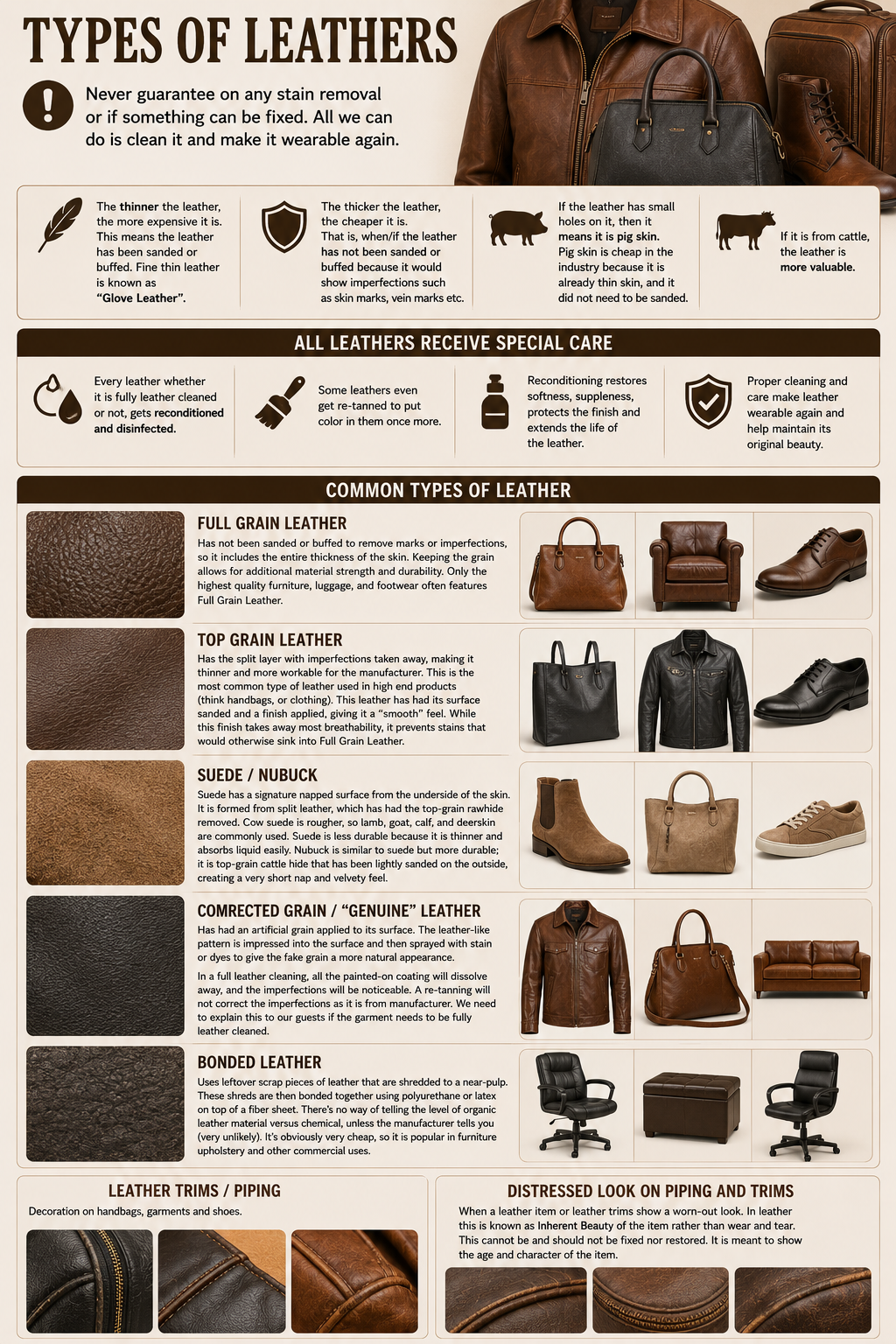
- Never guarantee on any stain removal or if something can be fixed. All we can do is clean it and make it wearable again.
- The thinner the leather, the more expensive it is. This means the leather has been sanded or buffed. Fine thin leather is known as “Glove Leather”.
- The thicker the leather, the cheaper it is. That is, when/if the leather has not been sanded or buffed because it would show imperfections such as skin marks, vein marks etc.
- If the leather has small holes on it, then it means it is pig skin. Pig skin is cheap in the industry because it is already thin skin, and it did not need to be sanded.
- If it is from cadle, the leather is more valuable.
- Every leather whether it is fully leather cleaned or not, gets reconditioned and disinfected.
- Some leathers even get re-tanned to put color in them once more.
Type of leathers used on handbags, shoes, luggage’s are usually Full Grain Leather which means the leather has not been sanded or buffed to remove marks or imperfections, so it includes the entire thickness of the skin. Keeping the grain allows for additional material strength and durability. Only the highest quality furniture, luggage, and footwear often features Full Grain Leather.
Top-Grain Leather has the split layer with imperfections taken away, making it thinner and more workable for the manufacturer. This is the most common type of leather used in high end products (think handbags, or clothing), you’ve likely seen it everywhere. This leather has had its surface sanded and a finish applied, giving it a “smooth” feel. While this finish takes away most breathability, it prevents stains that would otherwise sink into Full Grain Leather.
Suede well-known to most, suede has a signature napped surface from the underside of the skin. Technically suede is formed from split leather, which has had the top-grain rawhide removed to leave behind the drop split. This can be further divided or sanded down to reach the appropriate thickness. There are a variety of techniques to create suede (different splits, sanding, etc.), but its signature is its textured feel. Cow leather has a rougher feel, so lamb, goat, calf, and deerskin are commonly used instead. Although suede feels great, it’s less durable because its thinner and absorbs liquid easily due to its porous surface. Similar to suede but generally regarded as being more durable, nubuck is top-grain cattle hide leather that has been lightly sanded on the outside. This creates a very short nap, giving leather its signature velvety feel.
Corrected-Grain/” Genuine” Leather has had an artificial grain applied to its surface. The leather-like pattern is impressed into the surface and then sprayed with stain or dyes to give the fake grain a more natural appearance.
- This means that in a full leather cleaning all the painted-on-coating will dissolve away, and the imperfections will be noticeable. A re-tanning will not correct the imperfections as it is from manufacturer. We need to explain this to our guests if the garment needs to be fully leather cleaned.
Bonded Leather At the bottom of the pyramid, bonded leather uses leftover scrap pieces of leather that are shredded to a near-pulp. These shreds are then bonded together using polyurethane or latex on top of a fiber sheet. There’s no way of telling the level of organic leather material versus chemical, unless the manufacturer tells you (very unlikely). It’s obviously very cheap, so it is popular in furniture upholstery and other commercial uses.
Leather Trims/ Piping is decoration on handbags, garments and shoes.
Distressed Look on Piping and Trims is when a leather item or leather trims show a worn-out look. In leather this is known as Inherent Beauty of the item rather than wear and tear. This cannot be and should not be fixed nor restored. It is meant to show the age and character of the item.
QUESTIONS
Frequently asked questions.
These are some of the practical questions people often ask before getting started.
What should I expect during the first session?
The first session usually begins with a short conversation about your goals, followed by the service itself and time to talk through any next steps.
Do I need to prepare anything before booking?
You usually do not need much to get started. Arrive a few minutes early, bring any relevant notes if helpful, and wear whatever feels appropriate for the setting.
How do I know which service is right for me?
If you are unsure where to begin, start with the option that feels closest to what you need now. The first session can help clarify the best direction from there.
When should I get in touch directly?
Reach out directly if you have scheduling questions, need a specific accommodation, or want to confirm that a service is the right fit before booking.